
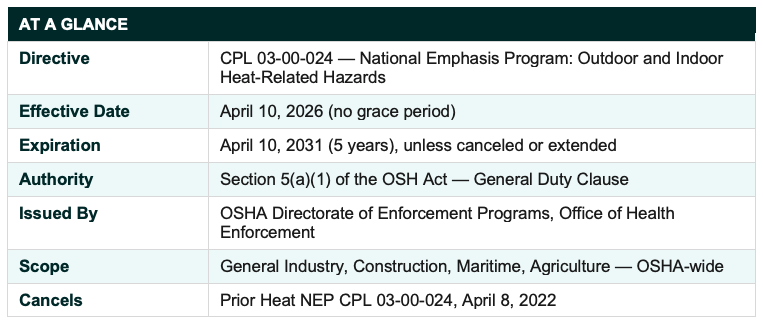
The U.S. Occupational Safety and Health Administration (OSHA) renewed its National Emphasis Program (NEP) for Heat Illness Prevention. It’s effective immediately as of April 10, 2026; there’s no grace period! OSHA regional and area offices are already authorized to conduct these targeted NEP inspections. The program runs for the next 5 years, expiring April 10, 2031. Are you ready?
Fun Fact: Did you know that the heat index considers BOTH temperature and humidity, giving a more accurate “real feel” with the weather than just a temperature measurement alone. The higher the humidity, the harder it is for anyone to cool down.
Heat illness is one of the most preventable occupational hazards. Keep in mind that the cost of prevention is far lower than the cost of a citation, workers’ compensation claims, or a fatality.

1. What Changed — The Regulation Update
OSHA’s updated NEP on Outdoor and Indoor Heat-Related Hazards is a continuation and meaningful strengthening of the Heat NEP that was originally issued in April 2022. So, it’s not a brand-new standard, but a significantly updated enforcement framework that employers should treat as an active and immediate priority.
Key changes from the 2022 version:
- Updated target industry lists resulting in 22 newly added industries and 46 removed industries.
- Revised inspection goal with stronger emphasis on on-site (in-person) response for complaints and all employer-reported heat-related hospitalizations.
- New Appendix I — Evaluation of a Heat Program: a formal 11-point checklist inspectors will use to assess employer programs.
- New Appendix J — Citation Guidance: detailed instructions for how OSHA inspectors will build and document General Duty Clause citations for heat violations.
- OSHA compliance officers are now explicitly directed to stop and initiate inspections of outdoor worksites observed in plain view while traveling on any day NWS issues a heat warning or advisory.
By the numbers: OSHA data from 2021–2024 shows an average of 48 heat-related worker fatalities and 3,793 days-away, restricted, and transfer (DART) cases per year — figures OSHA acknowledges likely undercount the true toll. Federal OSHA conducted approximately 2,400 heat inspections per year between 2022 and 2025.
2. Effective Date
The renewed NEP is effective immediately as of April 10, 2026. OSHA regional and area offices are already authorized to conduct targeted Heat NEP inspections under this directive. The program runs for up to five years, expiring April 10, 2031, unless canceled or extended.
Additionally, OSHA proposed a formal Heat Injury and Illness Prevention Standard in August 2024. That rulemaking process is ongoing. Until a permanent standard is finalized, OSHA will continue to cite heat hazards under the General Duty Clause — and this NEP provides the enforcement framework for doing so.
3. Who Does This Apply to in the Automotive Industry?
The NEP applies OSHA-wide across general industry, construction, maritime, and agriculture. Within the automotive and related sectors, the following industries are specifically named as targets in Appendix A of the directive:
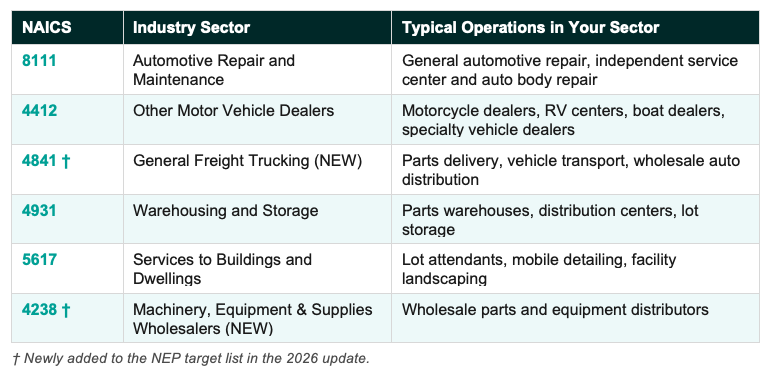
Even businesses not on the formal targeting list remain subject to heat inspections triggered by complaints, referrals, hospitalizations, or plain-view CSHO observations. Parts stores, RV centers, motorcycle dealers, and auto body shops should treat this NEP as operationally applicable to them, regardless of NAICS listing.
Common heat exposure scenarios in automotive operations:
- Service technicians working in bays without adequate air conditioning or ventilation during summer months
- Lot attendants, porters, and detail staff working outdoors in direct sunlight for extended periods
- Parts runners and delivery drivers moving between hot vehicles and hot facilities throughout the day
- Body shop workers near paint curing ovens, welding stations, and spray booths
- Workers wearing full PPE (respirators, coveralls, chemical-resistant suits) in warm environments
- New or returning employees not yet acclimatized to heat conditions
Important Note for New Vehicle Dealers (NAICS 4411) Not Part of the NEP Target List
NAICS 4411 — Automobile Dealers (franchised new and used vehicle dealerships) — was included in the 2022 Heat NEP but has been removed from the 2026 updated target list. This means franchised new vehicle dealerships are no longer among the industries OSHA will proactively schedule for programmed Heat NEP inspections.
However, this is not a free pass. OSHA retains full authority to initiate a heat inspection at any dealership in response to a complaint, referral, severe injury report, or a compliance officer’s plain-view observation on a heat advisory day. Removal from the programmed targeting list is not a shield from enforcement — the heat hazard risk for dealership workers has not changed, and a heat illness prevention program remains essential.
4. What Your Facility Needs to Do
OSHA inspectors conducting Heat NEP inspections will use the formal 11-point checklist in Appendix I of the directive to evaluate your heat illness prevention program. This is the exact standard your program will be measured against. Use this same checklist now to assess where your gaps are.
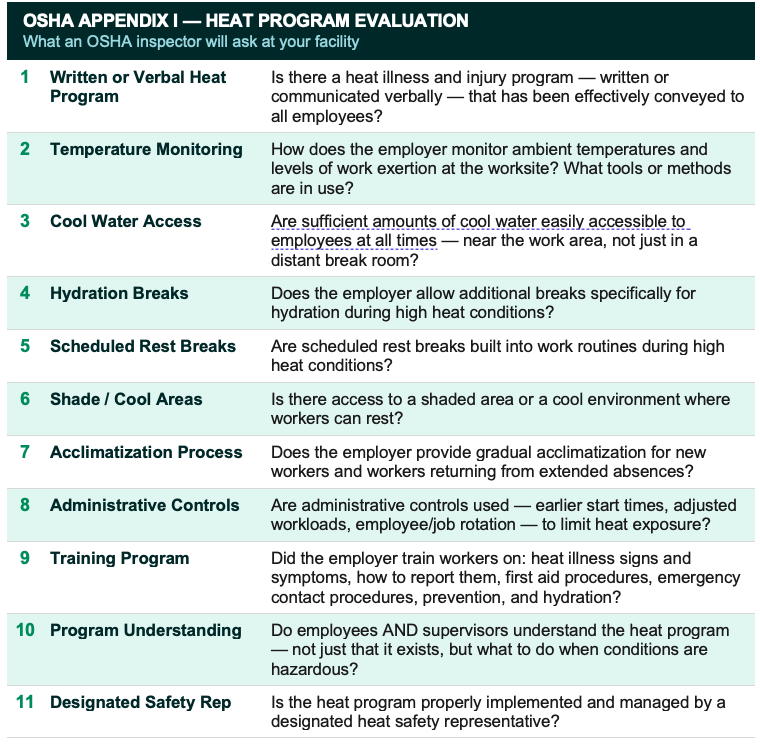
In addition to the Appendix I checklist, inspectors will also:
- Review OSHA 300 logs and 301 incident reports for heat-related illness entries
- Review records of emergency room visits and ambulance transport, even where hospitalization did not occur
- Interview workers individually for symptoms of headache, dizziness, fainting, or dehydration
- Document specific heat sources, PPE worn, workload levels, and duration of exposure
- Take wet-bulb globe temperature (WBGT) measurements and record NWS heat advisory data
- Check your prior OSHA citation history for heat-related violations
5. KPA’s Recommended Guidance
KPA’s Position: Every employer should have a Heat Illness Prevention Program.
KPA strongly recommends that ALL employers — regardless of whether they appear on OSHA’s NEP targeting list — implement a formal heat illness prevention program. Heat illness is one of the most preventable occupational hazards, and the cost of prevention is far lower than the cost of a citation, a workers’ compensation claim, or a fatality.
This is not just a compliance position — it is an employee safety position. Workers in automotive service, on vehicle lots, in body shops, and in parts warehouses face real and serious heat exposure risks every summer. Protecting them is the right thing to do.
Build Your Program Around These Core Elements:
Have a Written Heat Illness Prevention Program.
Create a written program specific to your facility and communicate it to all employees before heat season begins. At a minimum, it should address your monitoring approach, access to water and rest, acclimatization procedures, training requirements, and emergency response protocols.
Assign a Designated Heat Safety Coordinator.
Designate a specific person — a service manager, safety manager, or senior supervisor — as the heat safety coordinator. This individual monitors conditions, ensures protocols are followed, and serves as the first point of contact for heat illness reports. OSHA’s Appendix I checklist specifically asks whether this role exists and is functioning.
Monitor conditions daily during heat season.
Use the free OSHA-NIOSH Heat Safety Tool app to check the current and projected heat index each morning. A heat index of 80°F or above triggers heightened precautions. At 95°F or above, conditions are at the Danger level. Document your daily monitoring — inspectors may ask for it.
Ensure water, rest, and shade are readily available.
Cool, potable water must be accessible near the work area — not just in a distant break room. NIOSH recommends one cup of water every 15 minutes in hot conditions. Rest areas (air-conditioned or at minimum, shaded) must be accessible without requiring supervisor approval each time.
Implement an acclimatization schedule.
New employees and workers returning from more than a week away should not be placed immediately into full-heat work conditions. Build a gradual acclimatization schedule over 7–14 days, starting with lighter workloads and shorter heat exposure periods. Document this process.
Train all employees — and supervisors separately.
Training must cover: recognition of heat illness symptoms (heat cramps, heat exhaustion, heat stroke), what to do if a coworker shows symptoms, how to call for emergency assistance, the employer’s heat program, and the importance of hydration. Supervisors require additional training on monitoring workers and responding to emergencies. Document all training with dates and signatures.
Establish administrative controls.
Schedule the most physically demanding outdoor or hot-area work during cooler parts of the day. Use job rotation so no single employee is exposed to heat for extended periods. Adjust workloads on extreme heat days and build flexibility into scheduling during NWS heat advisories.
Prepare an Emergency Response Plan.
Every supervisor should recognize the signs of heat stroke — which is a life-threatening medical emergency — and be ready to call 911 immediately. Heat stroke symptoms include confusion, slurred speech, loss of consciousness, seizures, very high body temperature, and hot/dry skin. Do not attempt to manage heat stroke without emergency medical response.
Address indoor heat sources.
Do not overlook indoor environments. Body shops with curing ovens, service bays without adequate ventilation, and enclosed parts warehouses can all reach dangerous heat levels. Evaluate and implement engineering controls — fans, ventilation upgrades, radiant heat shielding — where feasible.
Document everything.
OSHA will ask for records during an inspection. Document your written program, daily heat index monitoring, training sessions with attendance, acclimatization schedules, and any heat-related incidents or near-misses. Good record keeping is your first line of defense in an inspection and your early-warning system for program improvement.
| The Bottom Line
OSHA is actively targeting heat hazards in automotive and related industries under this five-year NEP. An inspector can walk into your service center, body shop, or parts operation on any day the National Weather Service issues a heat advisory — and they will evaluate your program against the 11-point Appendix I checklist. The good news: Compliance is achievable. Download the Heat Illness Checklist and know that KPA is here to help. We have both on-site consultants and heat illness prevention training resources, program templates, and compliance support tailored to your industry. Get in touch with the KPA team today. |