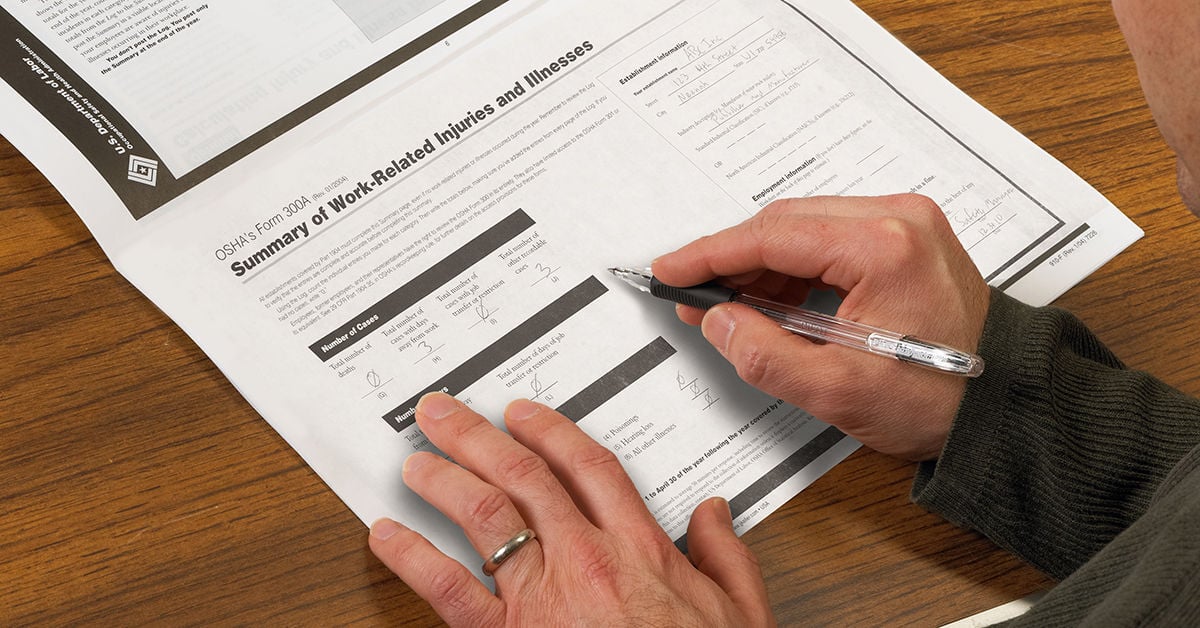
What Is an OSHA 300 Log?
The OSHA 300 log is the Log of Work-Related Injuries and Illnesses that covered employers must keep under 29 CFR Part 1904. It's a running record of every recordable injury and illness at a single establishment, updated as cases happen.
"Establishment" means a physical location. A dealership with a showroom, service department, and detail bay at one address keeps one log. A group with a collision center across town keeps a second log for that location.
Getting the log right matters beyond the paperwork. It's one of the first things an OSHA inspector asks for. It shows where injuries cluster, whether that's the lift bays, the parts mezzanine, or the paint booth. It lines up with your workers' comp claims, and it shows which fixes are working. Here's more on how to maintain OSHA 300 logs as part of a dealership safety program.
For a single store, the log is the injury record an inspector will read first, so treat it that way.
Recordable vs. Reportable: What's the Difference?
Recording means entering a case on your 300 log within seven calendar days. Reporting means notifying OSHA directly: within 8 hours for a work-related fatality, and within 24 hours for an inpatient hospitalization, amputation, or loss of an eye.
|
|
Recording
|
Reporting
|
|
What it covers
|
Every work-related injury or illness that meets OSHA's recordable criteria
|
A fatality, inpatient hospitalization, amputation, or loss of an eye
|
|
Deadline
|
Within 7 calendar days of learning about it
|
8 hours for a fatality; 24 hours for the others
|
|
Where it goes
|
Your OSHA 300 log and Form 301
|
Directly to OSHA by phone, online, or in person
|
Every employer covered by OSHA has to report severe injuries, including employers that are exempt from keeping the log. A severe injury that's reported still gets recorded if you keep a log.
What Forms Connect to the OSHA 300 Log?
Three forms work together. The 300 is the running log, the 300A is the year-end summary, and the 301 is the detailed report behind each case.
|
Form
|
Purpose
|
When It Is Used
|
Who Sees It
|
|
Form 300
|
Running log of every recordable case at the establishment
|
Updated within 7 calendar days of each case
|
Employer; employees and their representatives on request
|
|
Form 300A
|
Annual summary of the year's totals
|
Completed after year end and posted February 1 through April 30
|
Posted for all employees to see
|
|
Form 301
|
Detailed incident report for each recordable case
|
Completed within 7 calendar days of each case
|
Employer; limited access for the injured employee and representatives
|
The 300A is the only form posted for employees. The 300 and 301 contain personal details, and privacy concern cases, like certain sexual assaults or mental illnesses, are entered without the employee's name. Learn how to use OSHA Form 301 and 300A data to drive corrective actions.
Which Shop Incidents Meet OSHA Recordable Criteria?
Start with work-relatedness. A case is work-related if something in the work environment caused or contributed to it, or significantly worsened a pre-existing condition. A technician who cuts a hand on sheet metal in the shop is work-related. A back that goes out at home over the weekend isn't, even if it shows up at work Monday.
A work-related case is recordable if it results in any of the following:
- Death. For example, a fatality from a vehicle falling off a lift.
- Days away from work. A technician misses two shifts after straining their back lifting a transmission.
- Restricted work or job transfer. A technician is put on light duty after a back strain on a lift.
- Medical treatment beyond first aid. A technician gets stitches or a prescription after a hand injury.
- Loss of consciousness. A painter passes out from solvent vapors in a poorly ventilated booth.
- A significant diagnosed injury or illness. A fractured finger from a dropped wheel, or a chemical burn from a detail product diagnosed by a doctor.
The most common judgment call is first aid versus medical treatment. OSHA's first aid list is specific, and anything beyond it counts as medical treatment.
|
First Aid (Not Recordable)
|
Recordable
|
|
Cleaning a cut and covering it with a bandage or butterfly strip
|
Stitches, sutures, or surgical glue to close the cut
|
|
Over-the-counter pain reliever at normal strength
|
A prescription medication, or an OTC drug at prescription strength
|
|
Flushing a chemical splash from the eye with water
|
Removing a metal shaving from the eye with tools beyond a cotton swab or irrigation
|
|
Wrapping a sprained wrist with an elastic bandage
|
A rigid splint or cast, or physical therapy
|
Recordable cases also feed your safety trends. See how to read OSHA Form 300 recordable cases as lagging indicators.
Who Must Keep an OSHA 300 Log in the Automotive Industry?
Employers with more than 10 employees at any time during the previous calendar year must keep the log, counted company-wide, unless the establishment's NAICS code is on OSHA's partially exempt list. Classification is set establishment by establishment, so check each location.
- Dealer groups: Count employees across the whole company for the 10-employee threshold, then keep a separate log for each establishment expected to operate for a year or more.
- New and used car dealers (NAICS 4411): Required to keep logs. They were added in 2015.
- Service-only rooftops and body shops (NAICS 8111): Automotive repair isn't on the partially exempt list, so these locations keep logs.
- Parts operations (NAICS 4413): Required to keep logs, and this category is on OSHA's designated industry lists for electronic submission.
- RV, motorcycle, and boat dealers (NAICS 4412): Partially exempt from routine recordkeeping, but they still have to report severe injuries.
- Within 7 calendar days: Record a new case on the 300 log and complete a Form 301.
- Within 8 or 24 hours: Report a fatality (8 hours) or an inpatient hospitalization, amputation, or eye loss (24 hours) to OSHA.
- February 1 through April 30: Post the 300A summary for the previous year.
- March 2: Submit data through the ITA, if your establishment is required to.
- 5 years: Keep the 300, 300A, and 301 forms for five years after the end of the year they cover.
Some automotive establishments also have to submit their data electronically through OSHA's Injury Tracking Application (ITA), based on headcount and NAICS code. Check each location against the lists on the ITA site.
What Are the Deadlines and Posting Requirements?
Before the 300A is posted or submitted, a company executive must certify it. That can be an owner, an officer, the highest-ranking official at the establishment, or that person's supervisor. Post it where you post other employee notices, like the break room or the time clock, in every location.
KPA for Automotive OSHA Compliance
Paper logs work at one store until someone forgets the seven-day window, or the 300A gets posted in March. Across multiple rooftops, the gaps multiply. KPA helps automotive employers track incidents and audits in one place, with logs and 300A summaries built from the same incident records, plus training and consultants who know dealerships and collision centers. Learn more about our OSHA compliance solution.
So when a technician gets hurt on a Tuesday, the right forms are filled out by the following Tuesday, and the store manager doesn't have to guess.
OSHA 300 Log FAQs
When should auto dealerships post the OSHA 300A?
From February 1 through April 30, covering the previous calendar year. Post it where employees normally see workplace notices, at every establishment.
What is the difference between first aid and a recordable case?
First aid is limited to OSHA's specific list, like bandages and over-the-counter medication. Stitches after a technician's hand cut make the case recordable.
Do dealer groups count employees by company or by location?
The 10-employee threshold counts the whole company. Logs are kept separately for each establishment.
Do body shops and service centers need to submit data through the ITA?
It depends on each establishment's headcount and NAICS code. Check them against OSHA's designated industry lists every year.