
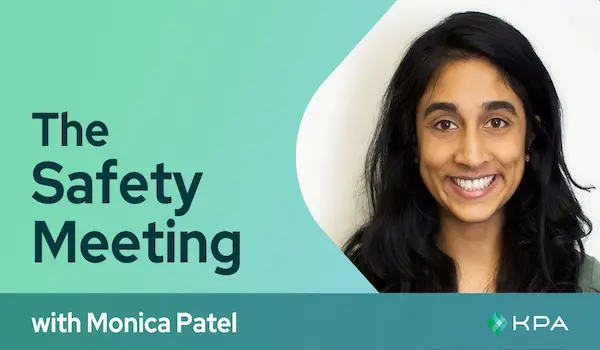
Today on The Safety Meeting: the ROI of Safety Tech. We’re speaking with KPA’s own Senior Product Manager, Monica Patel. Monica brings a strong background in engineering and operations with hands-on experience across energy, technology, and logistics industries. Monica’s expertise lies in leveraging technology to tackle complex safety and compliance challenges, making her a driving force behind KPA Flex. Her passion for enhancing operational efficiency and safety standards is reflected in her commitment to helping businesses integrate innovative solutions into their safety management practices.
Thanks for being with us today, Monica. It’s always a joy to have you on. Let’s jump into the questions. I wanted to start with the big picture. A safety manager walks into a C-Suite meeting to talk to the directors of their company asking for budget. When it comes to a new safety technology, what’s the strongest business case that they can make beyond just it being the right thing to do for the employees?
Yeah, great question. So the right thing to do is noble, but it just doesn’t close budget cycles, which is something that your C-suite is likely to care a lot about. So my opinion is that the strongest business case safety managers can make is really risk mitigation, but always tying it back to costs.
So, of course, it’s always about avoiding injuries, but it’s also about avoiding things like operational shutdowns, things like potential lawsuits, insurance premium hikes. How about brand damage? A major incident can definitely damage your brand. So think about Deepwater Horizon and BP; that happened over 10 years ago and the moment I say Deepwater Horizon you knew exactly what I was talking about. So, safety tech can be like a shield for the business when you quantify potential loss per incident. It only takes one major event to really create a compelling argument for your case, for your C-Suite.
[00:02:39]
I mean, that makes a lot of sense because you’re totally right. I knew exactly what you were talking about when you said Deepwater Horizon. So I can see how bringing up a big incident, talking about how it looks for the brand, can make a big impact. But when we’re actually talking about how to calculate ROI when it comes to safety tech, you’re essentially investing to prevent things that haven’t happened yet. So, what metrics should companies be tracking?
It can totally feel abstract because, as you said, you’re trying to measure something that didn’t really happen, right? So that’s exactly why we track things like leading indicators. So, leading indicators are things like near-miss reports, safety observations, and corrective action closure rates. These are metrics that show whether we’re actually getting ahead of issues before they escalate. So, over time, you can correlate improvements in those indicators with actual reductions in incidents, in things like compliance penalties, insurance claims, all of that good stuff. So really, like if a 50k investment leads to a 30% drop in recordables, that’s now actual measurable risk reduction.
[00:03:53]
And it sounds like with these workplace injuries, there’s a cost to everything, right? It’s almost like you have to look deeper into all of these things, like medical expenses, lost time, and regulatory fines. Are there some other hidden costs that Safety Tech ROI calculations can often miss?
Totally. So you’re absolutely right: Medical expenses, regulatory fines, those are the visible costs. Those are the things that people immediately think about, right? But the hidden costs, those could be things like damaging employee morale. It can create a lack of trust in leadership. Probably the biggest thing is that it can drive up your turnover. So all of those examples can now create a ripple effect: higher recruiting and training costs. Think about the lack of productivity that happens when an incident occurs; nobody’s really thinking about work. And then of course, things like increased operational drags. So, on top of that, you also lose valuable time managing investigations themselves, responding to audits, updating compliance documentation, and just communicating with your stakeholders. There’s a lot of effort that gets put into those things. And then, of course, like we talked a little bit ago, about how incidents can attract unwanted attention. You can certainly tarnish your brand and impact your future revenue anytime you have an incident.
[00:05:20]
Absolutely. Quick plug for The Safety Lab, our other piece of The Safety Meeting. If you haven’t listened to The Safety Lab yet, we deep dive into research studies in the safety field to tell you about the things that we’re finding. And one of the first ones we did for The Safety Lab was about psychological safety. Hearing you talk about how it can hit morale or make it so that people leave and your turnover costs are higher, I know how important it is to have that psychological safety net so that people feel good coming back to work after and injury and feel like they’re not going to be injured again. So I think understanding that there is a hidden cost of employee morale and losing people, is a huge one.
So when it comes to these technologies, I know that there’s a lot of options for the types of things that you should be tracking and what you should be looking at. So what sort of safety technologies are delivering the clearest, most measurable returns? Like what are the things that people are looking at and actually tracking, the pieces of technology that are actually helping companies focus in on safety, and where should they be putting their investments in this tech?
Yeah, so think about any tool that could replace, like a clipboard on location or spreadsheets, with real-time data. Like mobile inspection apps, automated alerts, analytics dashboards, those are all high-value pieces of digitization. So it’s really about collecting your safety data and doing something with that data to inform your program moving forward, always.
[00:06:48]
So you’re trying to look at things that are going to stop your people from having to get a piece of paper, fill it out, bring it back to the office, do all of that. Something that you can look at in real time and know what’s going on. So that before you send somebody into a ditch without knowing if they have training, you can check that on the spot. So all of these things, I’m sure a safety manager is sitting here and going, “Oh, that sounds so good. I would love to not have to do paper, and I would love it to just all be on my phone.”
But let’s talk about the implementation reality check. What are the most common roadblocks that companies are hitting when they try to roll out new safety tech, and how do those challenges impact the projected ROI?
Yeah, so two big ones here: change fatigue and data overload. People resist new tools that feel like extra work, right? Leaders definitely underestimate the need for clear onboarding and clear training when it comes to new software. So you really need to be thinking about ease of use when you’re looking at safety software, because if nobody’s participating, you’re obviously going to have a huge problem.
The second issue is buying tech without some sort of data strategy. You don’t want dashboards that nobody checks and alerts that get ignored. That defeats the whole purpose. So it’s super important for you to be really intentional about the rollout and ongoing enforcement, and there is all the more reason to be very intentional with your software choice.
[00:08:24]
That makes sense. If people aren’t going to use it and if it’s just going to be sitting as another thing for someone to do, I can see how it’s not going to be effective. And I know you mentioned also that changing routines is hard, so I think we should talk a little bit about how to handle that inevitable pushback, whether it’s from directors that don’t want to change what they’re doing, or people who are on the front lines that already know a routine, or maybe even executives that see the safety tech as a cost center rather than a profit driver. How do you handle that?
Yeah, so for frontline workers, you have to show them how the technology improves their day-to-day experience. If it reduces risk, streamlines their tasks, or prevents people from getting hurt, that message needs to be very clear and very consistent. If the tool feels like surveillance or creates more work, it’s an immediate fail. Nobody’s going to participate.
For people like executives, the conversation needs to shift from cost to impact. Safety tech is not just about avoiding losses; it’s also about creating a more resilient business. So, highlighting things like quick wins wherever possible, something as simple or as measurable as time to complete inspections, right? Faster corrective action cycles. Little wins like that can really reframe the narrative.
Once a stakeholder sees proof of actual momentum, then it becomes easier to build the broader buy-in, just like anything else that you’re working towards. A really great example that’s maybe not 100% safety-related, but I’m getting married in August, and I am on really strict dietary restrictions just to make sure that I am able to look my best in this dress, right? Well, after 30 days, if I don’t see any improvement anywhere, I am not going to keep eating salads. I’m going to go for the burger!
The same is true when it comes to your safety program, right? If you’re asking them to pause for a second and fill out a form digitally, you need to give them a little nugget, a little something like “great job,” to show them that they’re doing the right thing and that they’re on the right track.
[00:10:45]
You know, I think stickers for your hard hat go a long way. Or, you know what, even a bonus. A little bonus for all the first people who use the software, and the first person who completes the forms. A cash bonus, that’s what actually works; no stickers and pizza parties, give ’em a little cash.
While I say cash is a great way to incentivize people to start using safety tech, there are companies, of course, that are going to be resource-constrained. So, what’s your advice on prioritizing these safety tech investments? How do you sequence implementation and build momentum to prove the value that the executives are looking for?
So I would suggest starting where risk is highest and visibility is lowest. So if you’re a safety manager, you probably already have something in mind just hearing that. But maybe it’s a confined space entry. Maybe it’s something like contractor oversight. But the point is, that you just pick one area, you prove the value fast, and you build momentum in that way. Maybe you do a proof of concept, you get excitement from your team, and only then do you really want to move forward. So your momentum is really your greatest multiplier in a lot of ways. And really, it’s about finding the right software provider that’s going to work with you on the right implementation plan.
[00:12:07]
So you’ve got to have a really good plan in place to be able to move forward so that you can prove this. If you’re going in here willy-nilly, it’s going to be tough to actually make your case. I mean, hey, I feel like that’s just good advice in any piece of life!
So, looking ahead, what trends are you seeing that will strengthen the ROI case for safety technology in the next couple of years?
Yeah. So the first one I see, and it is everywhere, is AI, right? AI in safety. I used to think that this was just a buzzword, but now I think we all know that it’s here to stay. People are doing some amazing things with AI, but really, what it’s doing is giving us foresight by analyzing historical incidents, things like near misses, things like environmental data. And now with the help of AI, companies can start to predict risk before it becomes reality. So it really shifts safety from being reactive to proactive. So that’s one.
Another might be that safety is now integrating with the rest of the business stack. It used to be that safety was just always in its own silo. But now we see that people are integrating their safety programs along with HR, along with operations, along with maintenance, to make it company-wide, to really make it a business initiative. That’s certainly a trend that we’re seeing.
And then last one: I think that today’s employees expect a company to invest in their well-being, right? So they are more likely to stay and perform and really advocate for an employer who visibly prioritizes their safety. That kind of culture alignment has a real impact. And you know, safety tech can be a tangible signal that leadership is serious about that.
[00:13:58]
Yeah, I can definitely see, especially in the younger generation, that being more of a criterion when you’re looking for a job in these fields to make sure that you are going to be safe and you’re going to get home to your family. And again, going to plug that psychological safety episode, right? We’ll link it down in the description for you. If you’re listening to this episode, go check that one out too, because it really is a driver when it comes to keeping people and making sure that your employees feel confident in what the company is doing if they feel psychologically safe.
So you’ve done a great job of covering all the points when it comes to the ROI of technology in the safety space and how you can quantify that, show it to your directors, what pushback they might get, and how to mitigate that pushback. But before we wrap, is there anything else you’d like to share with our listeners?
You know, just one more thing. Safety technology: It’s about culture and it’s about accountability. And I am a software product person, right? So my job really is to make that easier. It’s not just about shipping new and exciting features as it pertains to our software, but it’s also about enabling change.
[00:15:10]
Absolutely. I love that. It’s tough to see that sometimes, so that’s a great reminder. Well, thank you again for being with us. It’s always great to talk to you. It’s great to hear what you’re seeing in those trends and how to make that case, because I’m sure that every safety manager who’s listening would much rather something digital than a piece of paper. So here’s hoping that they can all take what they learned here and apply it to make those moves for their next budget cycle.
Awesome. Thank you so much for having me.
Related Content
Explore more comprehensive articles, specialized guides, and insightful interviews selected, offering fresh insights, data-driven analysis, and expert perspectives.